
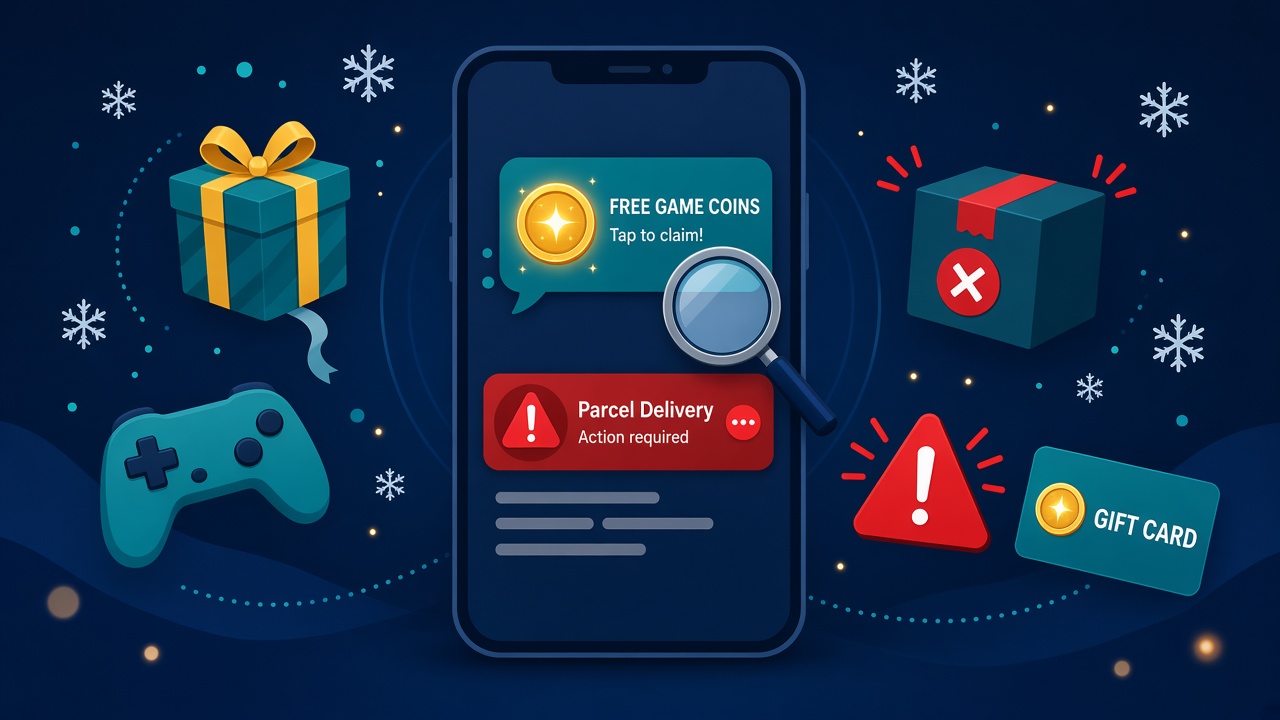
Black Friday lands on 27 November this year, and in many homes the Christmas countdown has well and truly started. Children are writing wish lists and chasing that one skin or bundle in their favourite game. Scammers know all of this, and plenty of their festive tricks are aimed squarely at children and teenagers.
In our last post, Before You Wrap It, we looked at setting up a new device safely. This week is about the scams themselves: what they look like on your child’s screen, and the simple habits that stop them working.
The scams most likely to reach your child
“Free V-Bucks” and “free Robux”
This is the big one for younger gamers. A video, a message or a website promises free in-game currency, often with a countdown to make it feel urgent. The NSPCC explains that these offers are often phishing scams, designed to get a player to hand over their username and password.
Roblox is very clear about it. Its support page says any offer of free Robux, subscriptions or valuable items is a scam, and that the goal is to take the account along with all its Robux and items. It tells children never to type their password anywhere except the real Roblox login page.
Deals that are too good to be true
Fake shops and social media adverts are not just a grown-up problem. Teenagers with their own cards, or with access to yours, can be drawn in by a half-price console or trainers from a shop nobody has heard of. Report Fraud lists fake online stores, counterfeit goods, items that never arrive and fake order confirmation emails among the most common online shopping frauds.
Parcel delivery texts
With so many parcels on the way in December, “missed delivery” texts are everywhere, including on children’s phones. Which? says the warning signs include a message from an unknown mobile number, pressure to act quickly, a link to follow, and claims that your address is incomplete or there is postage to pay. If there really is a problem, the courier or retailer will contact you another way or simply try again.
Gift card tricks
Gift cards are popular stocking fillers, and scammers love them for the same reason children do: they are quick and easy to spend. Which? warns about social media posts offering free or heavily discounted gift cards that lead to sites harvesting personal and financial details.
The golden rule for every age: a gift card is for a gift. If anyone asks you or your child to pay for something, “verify” an account or claim a prize using gift card codes, it is a scam.
Why children are easy targets
It is not because children are careless. These scams are built around things children care about deeply: fitting in, keeping up with friends and getting the latest item in the game. Add a ticking timer and the fear of missing out, and even a sensible child can tap before thinking.
Adults get caught too. On 30 October 2026, Report Fraud warned that criminals posing as Amazon had stolen £86,837 from victims in just nine days in October, in some cases by claiming gift cards had been added to a victim’s basket. Its advice is the same for all of us: pause, and check through a route you trust.
Five habits to teach this week
- Free currency is never free. No real game gives away V-Bucks or Robux through links, videos or generators.
- Passwords only go into the real app. Open the game or shop yourself, rather than following a link.
- Countdowns are a red flag. Real deals do not need you to decide in 30 seconds.
- Never share gift card codes. Not with a “friend” in a game, a seller, or anyone who messages first.
- Tell, don’t hide. If they have clicked something, they will not be in trouble for telling you.
Your Black Friday scam checklist
- Turn off in-app purchases, or set a spending limit, on consoles, tablets and phones. The UK Safer Internet Centre also suggests explaining that virtual currency costs real money
- Make sure purchases need your approval, and check your bank statement for anything unexpected
- Buy gift cards only from the official brand or trusted shops, and keep the receipt and code safe
- For unfamiliar shops, check reviews and pay by credit card where you can, as Report Fraud advises
- Show your child how to forward a suspicious text to 7726 for free, as Ofcom recommends. 7726 spells SPAM on a keypad
- Report scam messages, links and players inside the game using its own report button
If something has already gone wrong
Stay calm and thank your child for telling you. Change the game or account password straight away, and turn on two-step verification if it is available. If money has been taken, contact your bank or card provider immediately. Ofcom notes that many banks connect you safely if you call 159.
Then report it. In England, Wales and Northern Ireland, use Report Fraud online or call 0300 123 2040. In Scotland, contact Police Scotland on 101. Contact the gift card company too, as they may be able to block the card.
Final Thoughts
Christmas scams change their costumes every year, but the trick underneath is always the same: rush, excitement and a link. If your child learns to pause, open the app themselves and come to you when something feels off, most of these scams simply stop working.
Parent Tip
Instead of only saying:
“Don’t fall for scams.”
Try saying:
“If anything offers you free V-Bucks, free Robux or a crazy deal, bring it to me first. We’ll check it together, and you won’t be in trouble.”
It turns you into the first person they come to, not the last.
Watch the 30-second version on TikTok
Short on time? Watch our Black Friday scams video on TikTok, covering fake free Robux and V-Bucks, countdown deals, dodgy parcel texts and gift card codes in under 40 seconds. Then follow The Safe Click for more quick tips for busy parents.